
Stress Is Good, Actually
With the 2026 Olympics right around the corner, a never-before-told story of how Jordan Burroughs learned to embrace his nerves to win the gold medal.

“Pressure doesn’t exist unless you allow it to exist.”
—Rick Barry, Basketball Hall of Famer
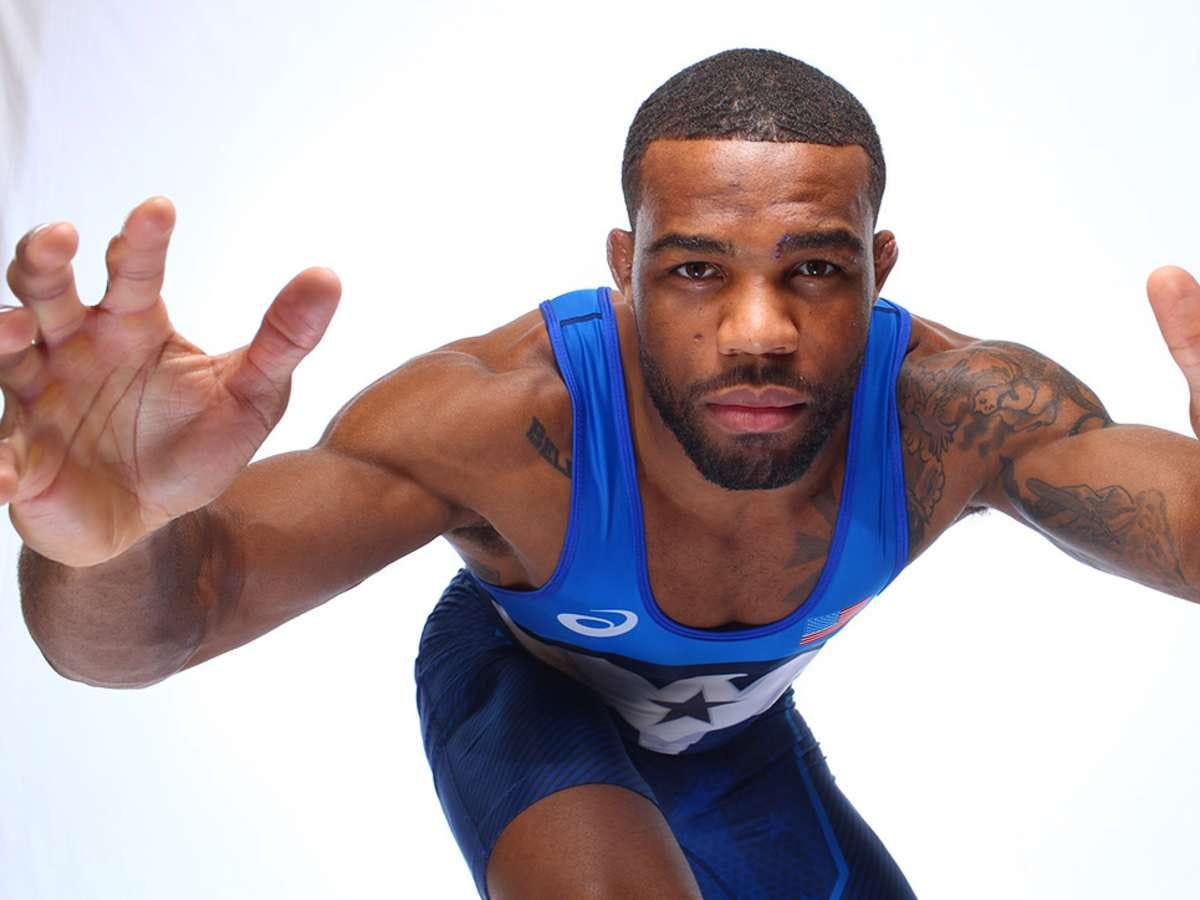
In the lead-up to the 2012 Olympic Games in London, freestyle wrestler Jordan Burroughs had been waiting for the nerves to hit him—for the pressure of the situation to settle over him like a weighted blanket. Friends and family kept asking, Are you nervous yet? But his answer never changed. The 163-pound athlete, who was coming off a title-winning performance in the 2011 world championships, just shrugged. “No, I feel good,” he told them. Not because he didn’t appreciate the magnitude of what he was hoping to achieve—winning a gold medal—but because it simply didn’t feel real.
Not until it did.
Before each of his matches, event organizers would place Burroughs in the wings of the ExCel Centre, the venue that housed the Olympic wrestling hall. He describes these moments in the tunnel as “the craziest time for me.” There he’d stand, “literally right next to” his opponent, waiting for his name to be called. His coaches rubbed his shoulders and whispered encouragements into his ear; his opponents’ coaches did the same, in incomprehensible foreign tongues. That’s when it would happen. That’s when it’d feel real. He says, “You have to wait for it to hit you, and when you’re in that tunnel, it hits you.”
Burroughs remembers the insect-hive sound of the packed-arena crowd exploding into the tunnel. He remembers the physical presence of his opponents, the feeling of his heart beating against his rib cage. He was so nervous before his gold-medal match against Iran’s Sadegh Saeed Goudarzi, in particular, he tells me, that he momentarily lost control of his body. “I was literally shaking.”
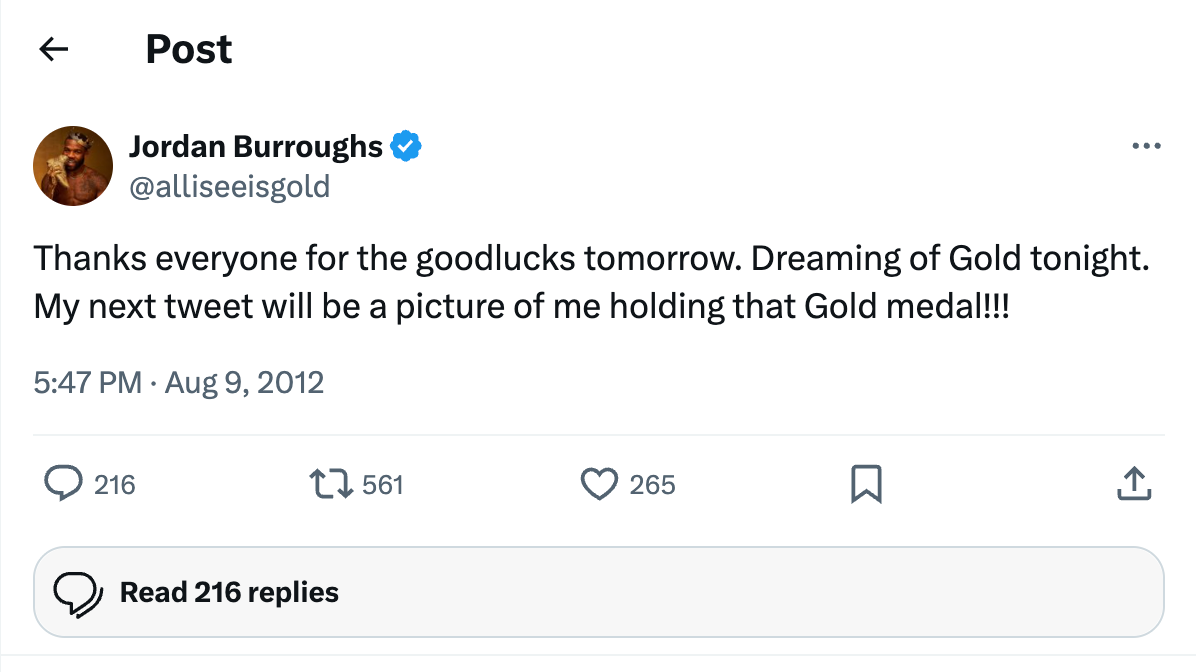
Burroughs knew he had more on the line than which color medal they’d ultimately drape around his neck. The day before, the wrestler had broadcast his confidence to his many thousands of Twitter followers (and to the rest of the sports media, who faithfully reported on his message), when he posted this to his @alliseeisgold user handle: “My next tweet will be a picture of me holding that Gold medal!!!” It was a boastful prediction along the lines of Muhammad Ali calling his round or Joe Namath guaranteeing a Super Bowl win—and it was hugely out of character within the typically stodgy sport of amateur wrestling.
Burroughs would be lying if he told you he didn’t feel extra pressure as a result—or that he didn’t allow a few doubts to creep into his pre-competition thinking. He could already imagine the ways in which the internet would have fun at his expense should he fail to deliver. “I was thinking, like, ‘What if I lose? What do I put next? What’s my next tweet? I got to delete my Twitter page,’” he says. “I’ll be a [crying] Jordan meme.”
In hindsight, Burroughs says it was a perfect cocktail of self-assurance and naivety that led to his social-media proclamation. “I just remember feeling so confident in my abilities,” he says. “I was the reigning world champion, still undefeated, fresh out of college, first Olympic games.” In those moments before they called his name at the ExCel Centre, when things briefly felt all-too-real, Burroughs reminded himself there was nowhere else on earth he’d rather be. “Because sometimes you just want to escape. You’re like, ‘Why did I dream this? Why did I want this? This is so hard. It’s so scary.’”
And he’d made it even scarier. That had been his doing.
All that was left was the event itself—the event in which “the boastful 24-year-old American,” as the Associated Press called Burroughs at the time, would either back up his brash talk, or fail for all the world to see. Says Burroughs, “Expectation does two things to people. It either folds them, or they rise to the occasion.”
And he had no plans to delete his Twitter account.
***
According to performance psychologist Michael Gervais, who spent a decade working with the Seattle Seahawks, it takes courage to talk trash. “Trash-talking is a way to actually increase somebody’s full embodiment and engagement, because it ups the ante from a social standpoint,” he says. For some people, talking trash prepares them to perform at a high level and strips away potential excuses for not giving their best. Chad “Ochocinco” Johnson has confessed to talking crap during his football career for just this reason. “It puts pressure on me to practice harder and play at a higher level,” he’s said. For others, however, that kind of confrontation—that explicit challenge, that stress—can create a potentially threatening situation.
As Georgetown assistant professor Jeremy Yip and his collaborators at the University of Pennsylvania’s Wharton School (where Yip is also a research scholar) put it in their study of trash talk in the workplace, people often signal their intent to either cooperate or compete with one another in social interactions, and talking shit “signals an intention to compete fiercely,” which not only highlights—or even increases—the demands of a competition, but also makes the prospect of losing much less palatable.
It should not be surprising, then, that trash talk is likely to cause activation on a biological level: anxiety spikes. “You have now introduced a threat. You have kind of thrown the gauntlet,” as one sports psychologist who works with the military puts it to me. Personally, I can confess that, on the very few occasions when I have talked real trash during games of pickup basketball, saying something to the effect of, “He can’t guard me, get me the ball,” I have regretted it instantly because I didn’t enjoy the added pressure and I questioned my ability to back it up.
My pulse quickened faster than I liked.
It’s not my fault, entirely. When any kind of threat is introduced, “it pings our danger center, the amygdala, and the reptilian brain,” explains Scott Goldman, a performance psychologist with the Golden State Warriors, who has previously served in similar roles for the Detroit Lions and Miami Dolphins, among other organizations. Trash talk taps into some of humanity’s most primal instincts, as our brains are basically programmed to find threats lurking everywhere. “It’s in our DNA to overestimate risk. It’s this whole ancient function to scan the world and find danger,” says Gervais. “This is a survival mechanism.” And it can be deeply disruptive to performance.
But not always.
***
A threat doesn’t have to be threatening. Even more important than whether we detect danger in our environment, and even more important than whether we experience an attendant anxiety spike—even more important than whether we are stressed, that is—is what we tell ourselves about that stress. “The key component within all of this is, how do we interpret these things?” says Mark Aoyagi, the codirector of sport and performance psychology at the University of Denver. “How do we make sense of these things?”
Whenever we experience stress, our brains do a kind of instant assessment. They take an inventory of our resources (our abilities) and weigh those against the demands of the situation. Our brains want to know: Do we have what it takes to succeed?

Think about being in a locker room before a game, backstage before a musical performance, or in a classroom before a final exam. Can you imagine feeling nervous? Your heart rate going up, your breathing getting fast, your palms starting to sweat?
That’s stress, that’s anxiety—and that’s not necessarily a bad thing.
On a purely biological level, that anxiety (or stress) is sign that your body is activating in order to take on a challenge. To respond to a potentially threatening situation. “The stress response, it’s a resource,” says Jeremy Jamieson, a professor of psychology at the University of Rochester, whose research focuses on the impact of stress on decisions, emotions, and performance. “It’s getting blood out to where it needs to go. When you’re being challenged, you want to be stressed. If you’re not stressed at all, that means you’re not sufficiently activating.”
This anxiety is, in a word, adaptive. Or at least it can be.
Some may balk at the idea that stress is good1 because we’ve been taught the opposite: that stress is bad—something to be feared and avoided. “In our culture, stress is seen as a negative,” says Jamieson. “But stress and distress get conflated. When people say, ‘I’m so stressed,’ they don’t mean, ‘I’m experiencing a lot of sympathetic arousal.’ They mean, ‘Something bad is happening.’”
And the irony is: something bad will happen—but only if we see it that way.
There’s a neuroscientist named Lisa Feldman Barrett, and she describes the importance of understanding stress in a positive way with this phrase: “Get your butterflies flying in formation.” In other words: it’s totally fine to feel nervous, to feel stressed. To feel those butterflies flapping around in your belly. Just make sure those butterflies are lined up like fighter pilots when it’s time to take on a challenge.
At work, at home, when dealing with kids, when waiting in the wings for a gold-medal match—however and wherever we show up in the world: if we want to be at our best, we need to stop fighting against our stress and start fighting with it by our side.
***
OK, now forget everything I just said.
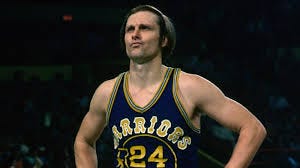
Because if you ask Rick Barry, the Basketball Hall of Famer will tell you there’s no such thing as pressure. “Pressure doesn’t exist unless you allow it to exist,” he says. “The only pressure you feel is what you put upon yourself.” Which isn’t to say Barry didn’t recognize that certain situations could seem more demanding than others, like when he was tasked with carrying his team to a championship in the 1975 NBA Finals; it’s just that, from his perspective, an individual should always feel that he or she has the resources to meet those demands.
“You train to be in [those] situations. You’re put in situations sometimes that are going to be exceptionally critical and just demanding of you to perform at a high level. That’s not pressure. It’s a situation where pressure can become a factor because of the enormity of the situation, because of the responsibility of the situation. But pressure will not exist if you have confidence in your ability to do what the hell it is you’re trained to do,” he says.
To tell yourself that you have what it takes to succeed.
That’s precisely what Jordan Burroughs tried to remind himself in the moments before his gold-medal match in 2012, when he found himself at a psychological crossroads in the tunnel at the ExCel Centre.
Burroughs remembers exactly what song was playing throughout the arena at that time: “Barbara Streisand” by Duck Sauce. To this day, if he hears that song, it zaps him back to the tunnel, where he could feel his nerves zooming into overdrive, his body shaking, and his mind beginning to race. In that brief moment, as Burroughs questioned why he had ever wanted this, he also allowed himself to consider how much nicer—and safer—it would be if he could just be a spectator in the stands instead of the man on the mat. But the wrestler understood what was happening. He’d felt this kind of stress before. He said to himself: “There’s no place in the world that I’d rather be.” He said, “I want to be here. I chose to be here. I fought to be here. This is my time.”
Bring on the pressure. Stress is good.
A decade later, I asked Burroughs: Did he actually believe that when he said it? That there was nowhere else he’d rather be?
His response: “I just made myself believe it.”
As he waited in the wings, Burroughs almost meditated on how hard he’d worked to get to this point. I like to imagine a series of images playing in his mind’s eye like one of those training-montage scenes from Rocky. “That has been the reoccurring theme throughout the entirety of my career,” he says. “Dialing myself in and saying, ‘I’ve done all the work. I’ve lived my life the right way. I’ve made the sacrifices. I’ve been coachable. I’ve treated my body right. I’m capable of winning. I am willing to win. I deserve to win. I’m going to go out here and put it on the line.”
Burroughs still felt the pounding of his nerves, of course: the dance-hall beat of anxiety. “When you step out, your heart’s beating, it’s pumping, and you’re just like, ‘Man!’” he says. But at that point, there was no turning back. “There’s no escape.”
There’s nowhere I’d rather be.
The time came and the announcer called his name: “Jordan Ernest Burroughs.” And then, as the wrestler prowled the mat in a pre-match lap—as he shook the Iranian’s hand mere seconds before the ref’s starting whistle—something utterly bizarre yet wholly familiar happened. It all came into focus. Burroughs could feel himself dialing in. He believed it now, or at least believed it enough.
Per Burroughs, “When the ref blows the whistle, you almost enter into this time warp where nothing else around you matters. Anything outside of that circle doesn’t exist. You’re like in the matrix. You just settle into this place where your body takes over. There’s not a lot of thinking happening. Everything that’s been learned and practiced repeatedly, just this instinctual muscle memory takes over your wrestling, and you just go out there and compete.” He didn’t think about what was at stake, about the global eyes that were on him, about the possibility of looking foolish. He’d earned the right to be in this position and to have these nerves—he understood that this stress was a privilege—and he knew he could win. The only thing that mattered now was the next six minutes of wrestling.
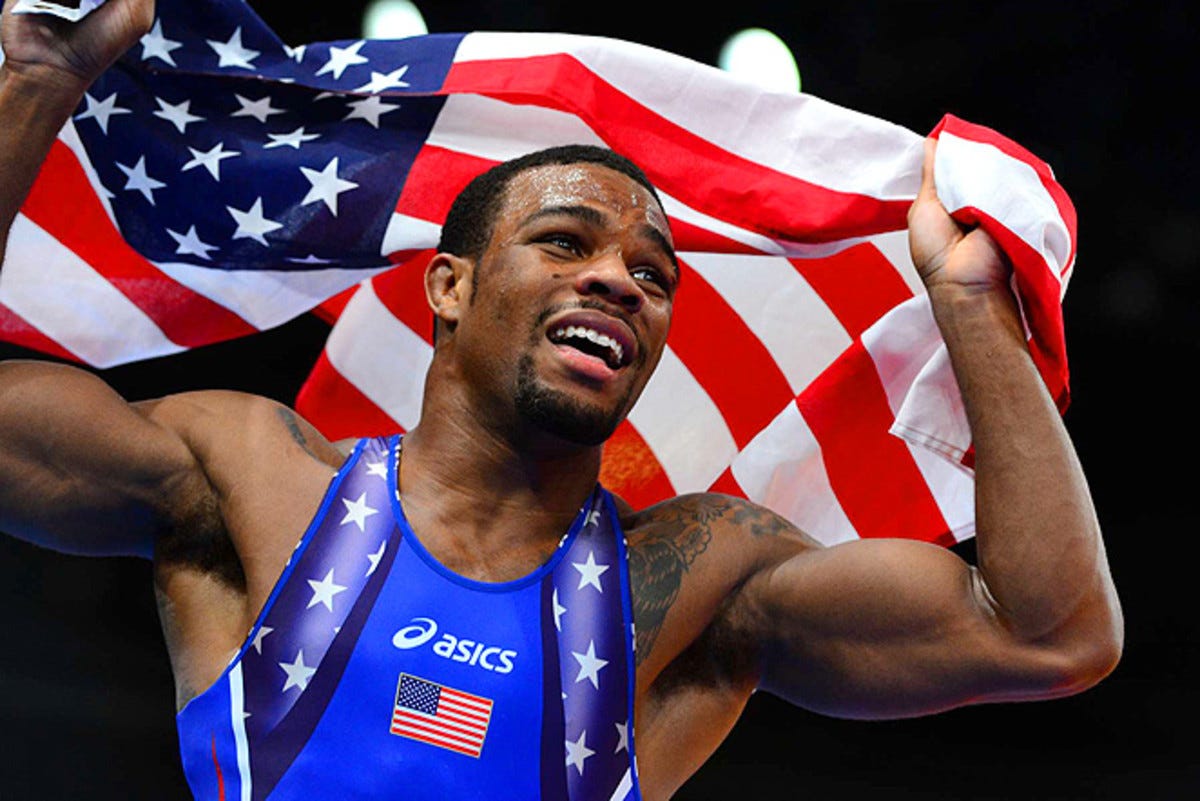
Burroughs still remembers what song was playing after the match was over, as well: “I Gotta Feeling” by Black Eyed Peas. He was smiling by that time, with an American flag draped across his back. Pretty soon he’d have a shiny gold medal around his neck, too—and a triumphant new picture to post on social media. 🗣️
To be clear, we’re talking about acute stress, not chronic stress.