
Sportsmanship Is Dead. Good.
On Taylor Townsend, Jelena Ostapenko, and who really needs an education.

If you haven’t already, buy a copy of my books Trash Talk and The Arena today!
“Sportsmanship is overrated.”
—Malcolm Jenkins, former NFL player
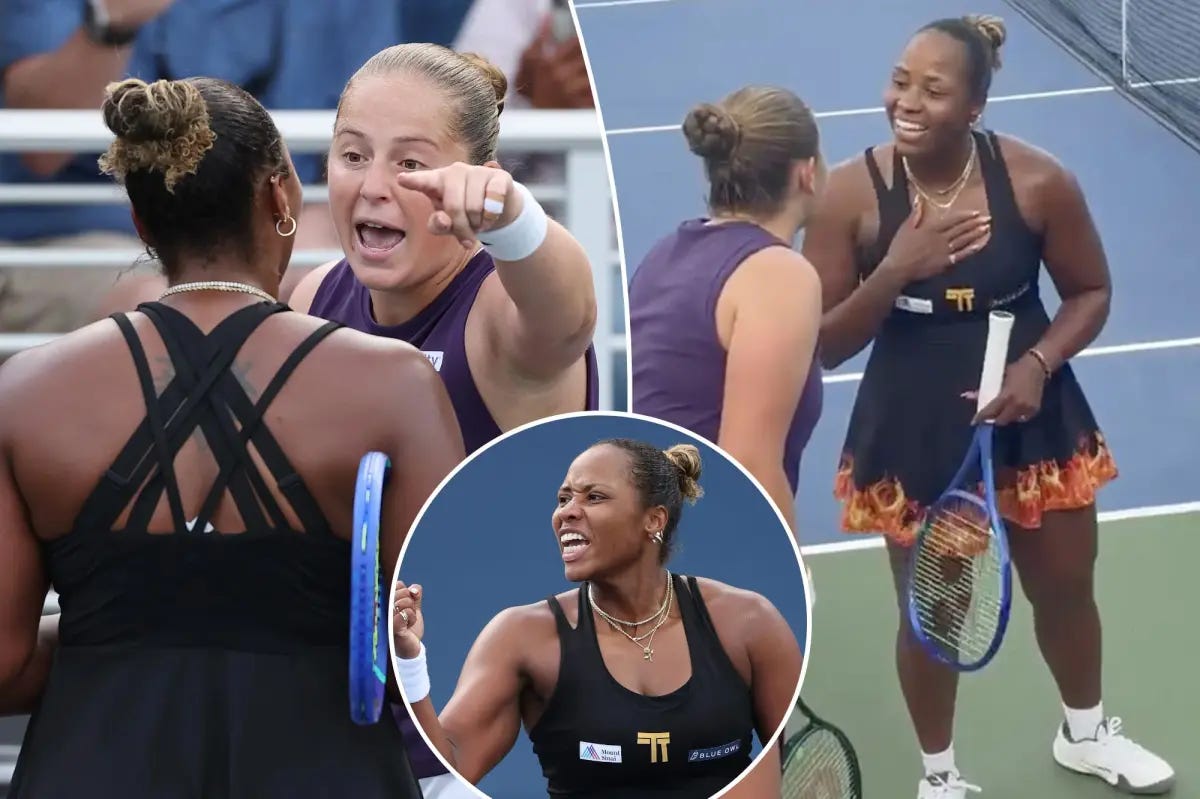
Earlier this week, the American tennis player Taylor Townsend beat Jelena Ostapenko of Latvia in straight sets in the U.S. Open. But the real drama happened after the match. As the two players met at the net for what’s normally a perfunctory handshake, Ostapenko hectored Townsend for not apologizing—one of tennis’s unwritten rules, to many—after one of her shots clipped the net and dropped in.
When Townsend said she didn’t have to apologize—and let’s be honest, would any of us really be sorry in such a situation?—the altercation escalated. Ostapenko told Townsend that she had no class and said, repeatedly, “you have no education.”
Her choice of words struck a nerve. Of course it did.
The behavior of Black athletes has always been under a high-powered microscope in the U.S. It’s for a reason Branch Rickey instructed Jackie Robinson not to respond to the racism and other abuse he’d endure on the field when he broke baseball’s color line: he didn’t want white crowds to feel that they were being challenged. He didn’t want them to feel threatened by the behavior of a Black man. Thankfully, those kinds of constraints quickly evaporated. (By the end of his career, Robinson became known as a vicious bench jockey.) But what hasn’t gone away is our desire to control other people’s behavior.
Which is where “sportsmanship” comes in.
In the early-1990s, America became obsessed with trash talk. For many, it was a new term—if not a new concept—and our collective curiosity was rewarded with a rash of trend stories in newspapers and national magazines that explored “trash talk” as a wholly new behavior of competition. It wouldn’t be long before that curiosity transformed into panic, though. The same media outlets that helped create a trash-talk phenomenon mere months earlier soon debated whether all this jabbering was symptomatic of coarsening on-court decorum—if sports were becoming “too street-oriented,” which everyone understood as a euphemism for “too Black”—and if it wasn’t time for a return to more sporting behavior.
White people were getting uncomfortable, and so league administrators responded by penalizing trash talk and trying to police it out of their games—all under the banner of “sportsmanship.”
But here’s the problem with that: sportsmanship has always been an imperfect concept. Much like “the spirit” of a particular sport, it lacks true objective measures. Instead, many of the professed values of sportsmanship, at least in the U.S.—things like humility, or disingenuously apologizing after your shot grazes the net—are often vague, discretionary, and “culturally relative,” as sociologist Herbert D. Simons argues in his 2003 paper “Race and Penalized Sports Behaviors.” The tenets of sportsmanship are also far from fixed: leagues often redefine what qualifies as unsportsmanlike—such as touching a referee—based on how they want to change player behavior at any given time.
But even more than that, just as what one person sees as playful banter another can see as “fighting words,” one person’s cultural expressions—such as talking trash or celebrating after an on-field success—can be another person’s taunting or showboating. Which is to say nothing of the very real differences in cultural sensitivities that make something more upsetting to one group than another.
Like the word bastard, for example.
(In Australia, affectionate. In India, super offensive.)
So there’s no such thing as being sportsmanlike, at least not objectively. And because of that, these differences in sensibility are fated to come into occasional conflict—especially in international competition, or in competitions that involve international players (like tennis tournaments). None of which is to say we can’t aspire to certain virtues, like always giving our best, or being gracious in both victory and defeat. But I do think it means we need to stop dressing up the idea of sportsmanship in whichever subjective values happen to resonate with any one particular group. Because that’s when it becomes a cudgel.
In the end, the only measure of sportsmanship that actually matters is whether we can each live up to our own ideals, not someone else’s. The behavior we should be policing is our own. In fact, this is one of the key lessons of trash talk: we can’t control what happens around us—or how other people behave—but we can control how we respond to it. And if nothing else, hopefully that response isn’t inflected with racism.1
When it comes to sportsmanship, maybe we could all use some continuing education.
Of Ostapenko’s comments, Naomi Osaka had this to say: “It’s one of the worst things you can say to a Black tennis player in a majority white sport.”
Wonderful points! I'd love to see something on "it's not whether you win or lose" and responses to the sports equivalent of gerrymandering.