
Holy Shit! Volleyball Rules!
And maybe it could be even better... if refs stopped telling female players how to behave.

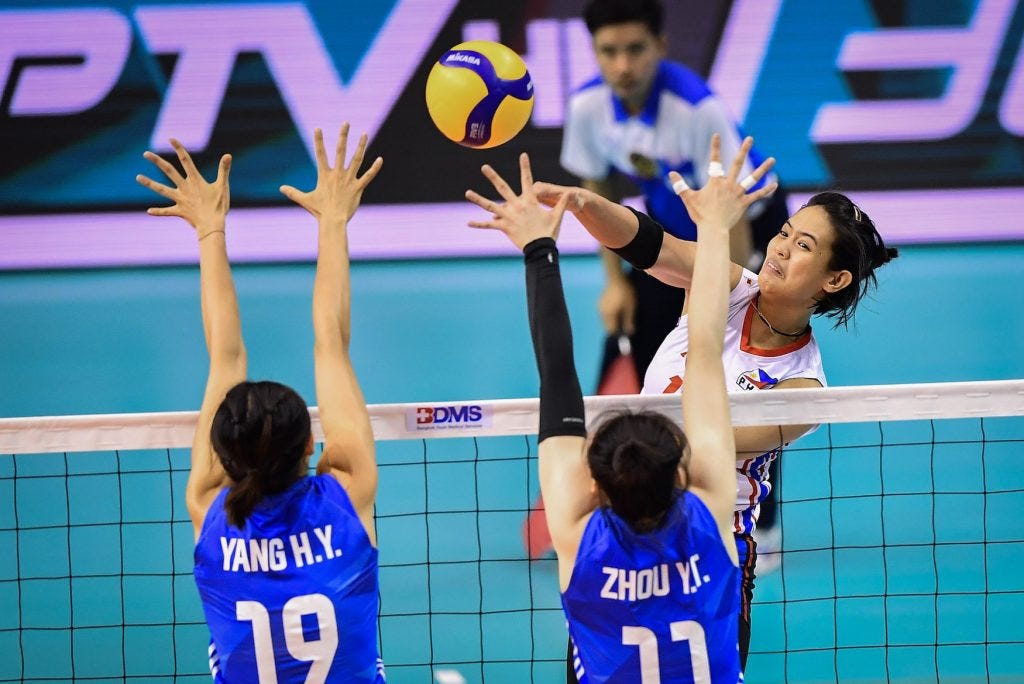
“You smell that?” —Anonymous
Just before the start of winter break, I flew to Kansas City to speak at the annual convention for American volleyball coaches. It’s quite an event, with thousands of attendees; a sprawling array of meet-ups, keynotes, and on-court educational sessions; and a jam-packed exhibit hall showcasing everything from the latest in uniform technology to massage therapy.
(The workers at the massage-therapy stall were particularly insistent, like merchants at a back-alley souk: Got a minute for a massage? You won’t regret it.)
As a sports fan—and sportswriter, for that matter—volleyball has only ever existed on the periphery of my awareness. I’d catch glimpses of matches every four years during the Olympics, or would make fun of my high-school friends who chose volleyball over baseball during the spring season. They’d tell us we didn’t understand the intensity and thrill of the game. We’d tell them to put their knee pads to better use.
But you know what? My friends were right! Volleyball fucking rules.
***
Before my week in Kansas City, I had never really immersed myself in the game, or watched an entire match of high-level competition (as it happens, the convention coincides each year with the NCAA women’s volleyball Final Four and championship). But the second I did? Man, I was hooked.
Who wouldn’t be?
As a sport, volleyball represents a test of skill, strategy, reflexes, and decision-making. It puts as much mental pressure on participants as it does physical pressure. After every point—each of which progresses with the unpredictable pacing of a pinball game—both teams must regroup, refocus. They must seize the next impossible angle of a kill shot. They must commit to the sprawling miracle of the next dig, the next save. But even with that short break, the edge-of-your-seat speed of the game is unrelenting.
To the uninitiated (i.e., me), it’s emotionally exhausting just to watch.
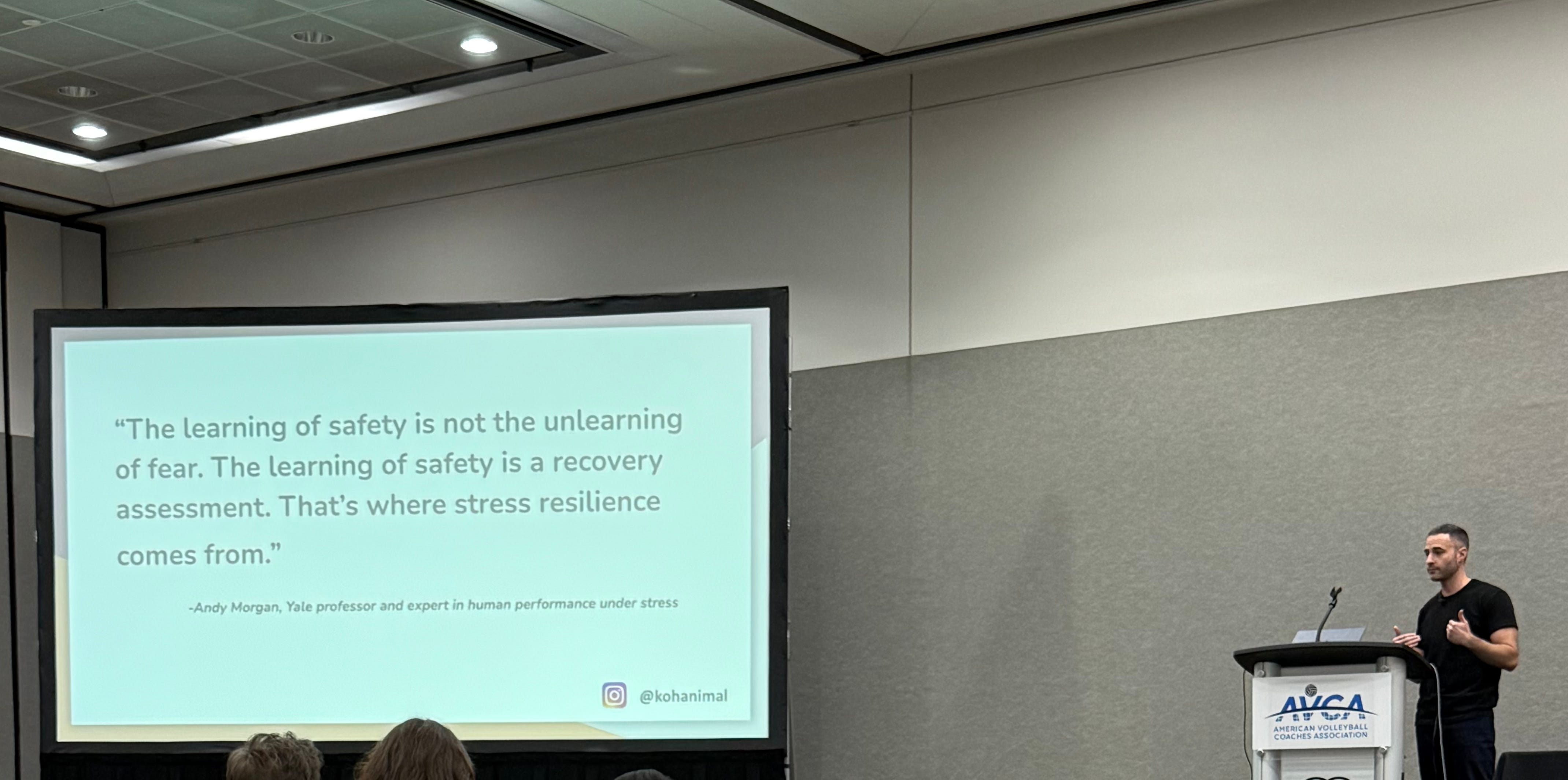
As I learned, the two most stressful actions on a volleyball court are serving and setting, because they’re the two actions that are most likely to send a player on an internal mental spiral, to get a player stuck inside her own head. To lead to the yips.
Volleyball is a game of momentum. And that kind of mental panic can be contagious, especially when the opposing team goes on an extended run. (Typically teams lose two-thirds of the points on which they serve, so racking up even a small run can be extremely valuable.) A single receiving error can lead to bad setter decisions, to giving free balls to the wrong person on the other team, to attacking the wrong areas of the court. That’s when everyone starts to get tight. When the mistakes mount, when pressure begins to overwhelm.
All of which is why having mental toughness—having practiced mental skills—is so crucial for high-level volleyball players. For players at any level, really. They need the ability to reset. To let go of past mistakes. To focus on the only thing that actually matters after every single point—which is: the next point—and to attack it without any fears of failure.
***
Given all that, it shouldn’t be a surprise that volleyball coaches might be intrigued by the lessons of trash talk. Not that they’d necessarily want a team of trash-talkers, but that they might recognize the unique stressors and potential distractions of trash talk as also providing a deeply relevant framework for developing the kind of mental toughness that’s necessary for all players. And sure enough, interest among the coaches abounded.
I should say: trash talk already exists in volleyball, though it looks different than it does in many other sports, constrained by the game’s structural peculiarities (two teams, divided by a net) and inherited behavioral norms (usually frowned upon). Indeed, despite the interpersonal intensity of the sport, visible aggression toward one’s opponents is regularly policed and can result in yellow or red cards. Per the rules, celebrations after winning a point must be directed toward one’s own teammates, not at opponents. Even a staredown—after a stuff-block, let’s say—can be interpreted as an unsporting infraction.
And especially if it comes from a female player.
That may be my biggest takeaway from Kansas City. It was certainly the question I got the most: about gender differences around trash talk. And while I would never pretend to be a behavioral biologist, the answer that I always give is that I believe that many of the differences we see are the product of socialization more than anything. Which is to say: people behave and express aggression in ways that they’re told are acceptable, in ways that go unpunished.

This answer resonated with many in attendance, and especially those who coach female teams. The former male players I spoke to had no problem recalling times that trash talk entered the fog of competition, despite the sport’s supposed gentlemanly mores. It could be anything from simple lines like “cake” or “easy” or “y’all don’t stand a chance,” to something more indecipherable. One guy told me about a couple of former high school teammates from Puerto Rico who would make vulgar promises about their opponents’ mothers. But because they did so in Spanish, their threats went unacknowledged and unpunished.
On the flip side, I heard stories about female players who were carded for even small expressions of competitive fire. One coach told me about a player who has been carded multiple times for her face—according to her coach, this player has “resting fuck-you face”—and once received an ejection for “standing too aggressively” from her seat on the bench. Seriously.
It’s not like female players are too delicate for trash talk.
Perhaps the best story I heard came from a high school girls game. As it was told to me: One player, after sensing some hesitancy from her opponents on a spike, began sniffing the court. “You smell that?” she said. Sniff, sniff. “You smell that?” Sniff, sniff. And then she dropped the one-word kicker… which I bet you can figure out.
Now I don’t know if this player got carded for that, though it’s easy to imagine that she did. And I have to wonder: is all that policing really necessary? Is it really protecting the game of volleyball from those who would violate its spirit? Or is it simply proscribing behavior that feels out of step from what we accept from women outside the lines?
Either way, it’s a shame. Because in many ways, volleyball is the perfect sport for trash talk. Not only does the game itself demand exactly the kind of practiced mental skills that trash talk tests, but also: the physical barrier of the net limits physical escalation, therefore lowering the chance for violent retaliation. In that sense, the challenge being presented can (or at least should) be understood as purely psychological—as a test of mental toughness. And certainly not as a threat to the fragile male ego of a referee.
So let the girls talk their shit, I say. And let the boys talk their shit, too. Because volleyball is already awesome, and maybe it can be even better. 🗣️